A FORWARD DEPLOYED ENGINEERING CASE STUDY
GLP-1 prior-authorization draft gate
The runnable graph is a hand-written synthetic policy overlay, not the published glp1-obesity CKG, and ckg-mcp is not loaded here. A nurse receives a synthetic GLP-1 request; the rule walk checks declared relationships, an optional verbalizer words the returned path, and a human reviews the cited draft.
Fictional regional payer · Synthetic patient cases · No submissions
The idea, without the jargon
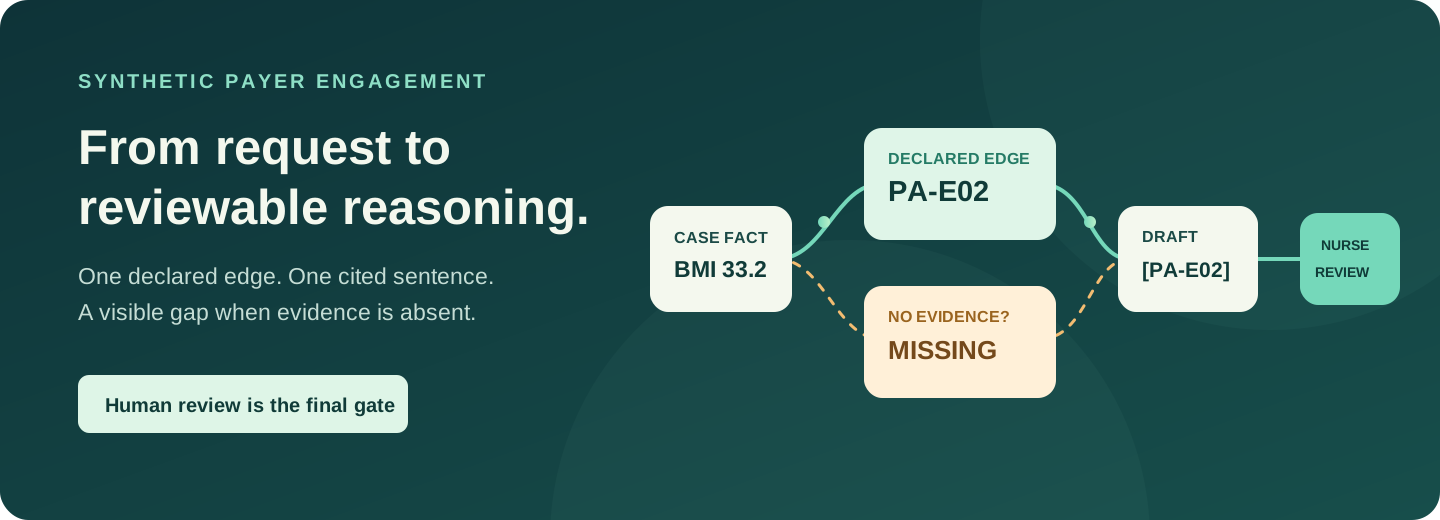
A prior-authorization request is a question: does this request meet this plan's rules, with enough evidence to say so? A search tool can find paragraphs that sound relevant. This demo uses a small, explicit map of relationships instead. Each rule has an ID, a source pattern, and a place in the path from request to draft. If the map cannot support a sentence, the draft says MISSING.
Graphify.md calls its product a Compressed Knowledge Graph (CKG). This page uses a tiny, hand-specified illustrative policy graph so you can see the consumer-side behavior. Here, “graph” simply means named things joined by declared relationships. A path such as Wegovy start → requires → BMI criterion is checkable. It is not a clinical diagnosis, a coverage decision, or a substitute for the nurse.
01 · The request
A fictional adult starts Wegovy injection for weight management. The case includes dose, BMI, labs, prior treatment, and safety fields.
02 · The path
The service walks declared synthetic policy edges. It checks submitted facts against each criterion and names missing or contradictory evidence.
03 · The handoff
Every draft line ends in a returned edge ID or MISSING. The optional verbalizer cannot add an edge. A nurse can accept or edit the draft review; the app cannot submit or approve a request.
One case, two outcomes
| Input | What the demo shows | Why it matters |
|---|---|---|
| BMI 33.2, start dose 0.25 mg, all required fields supplied | eligible_for_review, with PA-E02 and other edge citations |
A reviewer sees the exact policy path behind the draft. |
| Same case, eGFR omitted | needs_information, with PA-E08 under Explicit gaps |
The draft exposes the gap instead of filling it from a model's memory. |
eligible_for_review is a draft disposition, not a benefit approval. Both examples stay pending_review until a named reviewer acts locally. Walk through them in the app, or click the graph first.
What the frozen test split shows
| Result | 20 synthetic test cases |
|---|---|
| Invalid-action count | 0 |
| Abstention on out-of-graph asks | 100% (3/3) |
| Citation coverage | 100% |
| Criterion precision / recall | 1.00 / 1.00 |
The criterion labels were written against this same nine-edge fixture. The score shows the gate did not drift on that fixture; it does not establish generalization. See the evaluation design and limits.
What is real here?
The product concept, public FDA and payer source patterns, code, tests, and audit design are real. The payer, its policy graph, and all cases are synthetic. The private CKG creation process is not included. The demo is not a customer deployment or a clinical decision system.
Where to go next
- New to graphs? Explore one edge and one gap.
- Want to run it? Clone, start, and test two cases.
- Evaluating the engineering? Read how the graph, reviewer gate, and audit log work, then inspect the frozen evaluation.
- Assessing deployment judgment? Read the discovery note, action boundary, and handoff.