CKG Benchmark
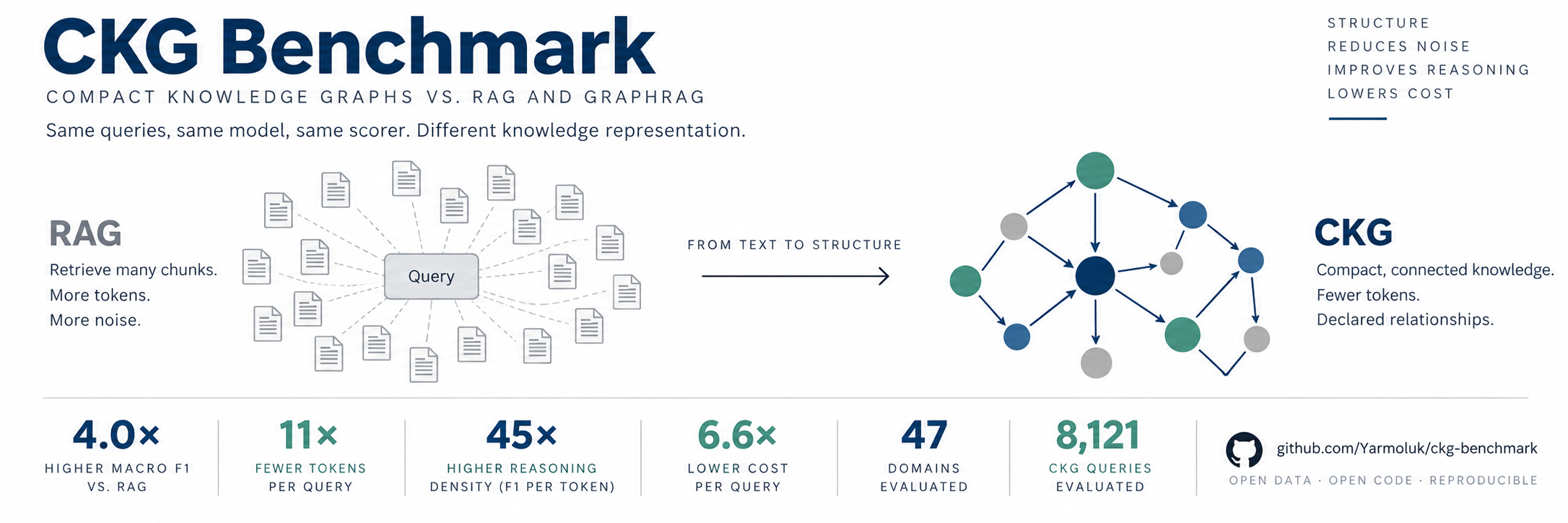
Benchmarking Knowledge Retrieval Architectures: RAG, GraphRAG, and Compact Knowledge Graphs
Daniel Yarmoluk (Graphify.md) · Dan McCreary







Research question
Retrieval-augmented generation (RAG) and graph-based retrieval (GraphRAG) both start from unstructured text and recover structure at query time. This benchmark asks a narrower question:
Quote
When a domain's knowledge already exists as an explicit dependency graph, how much answer quality and token efficiency is lost by discarding that structure and retrieving from prose instead?
A Compact Knowledge Graph (CKG) is the control condition: a directed acyclic graph of concepts, prerequisite edges, and taxonomy labels, stored as a plain CSV and served to the model as a small text subgraph. No vector index, no embeddings, no extraction step.
Headline results
All three arms send their retrieved context to the same model (Claude Haiku 4.5, temperature 0) and are scored with the same token-level F1 against the same ground truth. Numbers are regenerated from the committed result files by evaluation/analyze_results.py.
| System | Domains | Queries | Macro F1 | Tokens / query | RDS (F1 / tokens) | Cost / query (USD) |
|---|---|---|---|---|---|---|
| CKG | 47 | 8,121 | 0.493 | 264 | 2.16 × 10⁻³ | 0.00054 |
| RAG (FAISS, top-5) | 44 | 7,414 | 0.122 | 2,986 | 4.79 × 10⁻⁵ | 0.00354 |
| GraphRAG (local search) | 20 | 2,683 | 0.120 | 3,450 † | 4.52 × 10⁻⁵ | 0.00552 † |
† GraphRAG's CLI does not expose per-query token usage; the harness records a fixed estimate of 3,450 tokens.
CKG relative to RAG on this benchmark: 4.0× macro F1, 11.3× fewer tokens per query, 45× RDS, 6.6× lower cost per query.
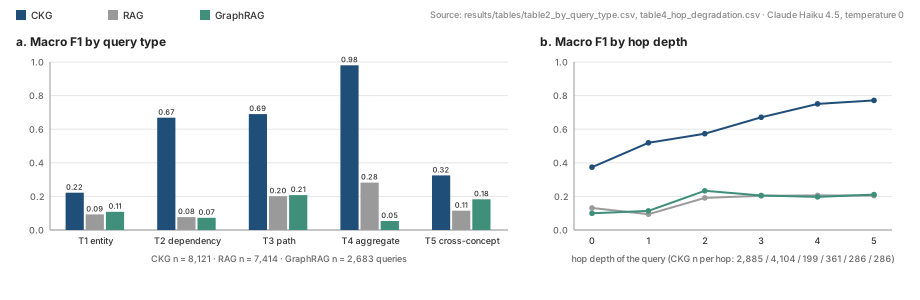
| System | T1 entity | T2 dependency | T3 path | T4 aggregate | T5 cross-concept |
|---|---|---|---|---|---|
| CKG | 0.222 | 0.668 | 0.690 | 0.980 | 0.325 |
| RAG | 0.093 | 0.077 | 0.201 | 0.282 | 0.115 |
| GraphRAG | 0.108 | 0.073 | 0.208 | 0.054 | 0.183 |
| System | hop 0 | hop 1 | hop 2 | hop 3 | hop 4 | hop 5 |
|---|---|---|---|---|---|---|
| CKG | 0.374 | 0.519 | 0.573 | 0.671 | 0.751 | 0.772 |
| RAG | 0.131 | 0.094 | 0.191 | 0.203 | 0.206 | 0.205 |
| GraphRAG | 0.100 | 0.114 | 0.233 | 0.205 | 0.197 | 0.211 |
| CKG queries at this depth | 2,885 | 4,104 | 199 | 361 | 286 | 286 |
The three architectures
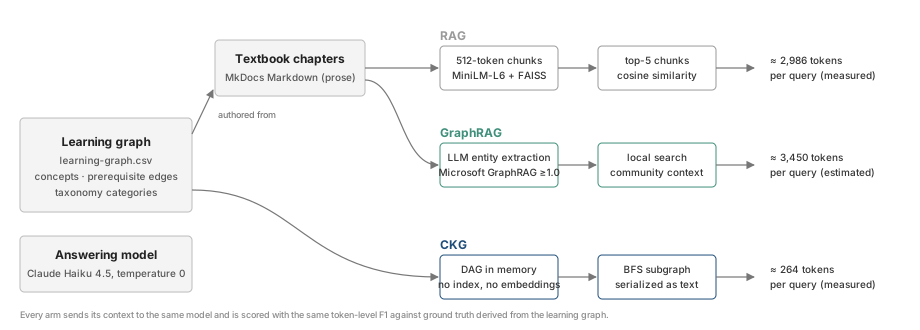
| RAG | GraphRAG | CKG | |
|---|---|---|---|
| Knowledge source | Textbook chapters (prose) | Textbook chapters (prose) | learning-graph.csv |
| Index | 512-token chunks, MiniLM-L6 embeddings, FAISS | Microsoft GraphRAG ≥ 1.0 entity graph | None; DAG in memory |
| Retrieval | Top-5 chunks by cosine similarity | Local search over communities | BFS over prerequisite edges |
| Answering model | Claude Haiku 4.5, T = 0 | Claude Haiku 4.5, T = 0 | Claude Haiku 4.5, T = 0 |
The prose corpus and the CSV are not independent: the McCreary textbooks were authored from their learning graphs, so RAG and GraphRAG are reconstructing structure that the CSV states directly. That is the intended comparison, and it is also a limitation.
Released data
| In the repository | Count |
|---|---|
| Learning-graph CSVs | 73 |
| Concepts | 13,773 |
| Prerequisite edges | 21,837 |
| Query files | 68 |
| Queries (T1 3,302 · T2 3,130 · T3 1,684 · T4 795 · T5 2,523) | 11,434 |
Ground truth is derived deterministically from the DAG by evaluation/generate_queries.py (seed 42); there is no human annotation. See Query Types and the Metrics Specification.
Limitations
The full list is in the repository README, section 7. The ones that most affect interpretation:
- The default CKG retrieval path reads
concept_id,path_ids, andtaxonomy_idannotations written into each query record; a text-only path exists in the harness but the published tables were not produced under it. - The prose corpus was authored from the graphs being evaluated.
- GraphRAG token counts are a fixed estimate; one RAG domain (calculus) has only 3 zero-token records; the no-retrieval control harness was run in dry-run mode only.
- The v0.6.2 paper reports an earlier locked run (44 domains, 7,758 queries, F1 0.4709) and cost figures priced with inconsistent constants; see
results/tables/RECONCILIATION-v0.6.3.md. - Single model, single run, no confidence intervals.
Navigate
- Paper · Results · Discussion
- Benchmark overview · Corpus index · Domains
- Getting started · Submit your system
- GitHub repository · Zenodo record
Citation
1 2 3 4 5 6 7 8 9 | |