The McCreary Intelligent Textbook Corpus
This section formally defines the corpus for the first time in literature.
Corpus Description
The McCreary Intelligent Textbook Corpus comprises 25 open-source educational textbooks hosted on GitHub. Each textbook contains a standardized learning graph encoded as a CSV file representing a directed acyclic graph (DAG) of concepts and their prerequisite dependencies.
The corpus spans three categories:
- STEM (11 domains): calculus, biology, genetics, bioinformatics, statistics, quantum computing, circuits, geometry, ecology, moss, functions
- Professional (7 domains): economics, organizational analytics, healthcare data modeling, database selection, conversational AI, automating instructional design, blockchain
- Foundational (7 domains): systems thinking, theory of knowledge, digital citizenship, prompt engineering, AI tracking, US geography, ASL
Key Statistics
| Statistic | Value |
|---|---|
| Concepts per domain | 140--550 (mean: ~267) |
| Total concepts | 12,260 |
| Total edges | 19,405 |
| Taxonomy categories | 1--19 per domain |
| Raw content | MkDocs Markdown (~3,000--8,000 words per textbook) |
Example: Calculus Learning Graph
The figure below shows the interactive learning graph viewer for the calculus domain, illustrating the DAG structure with color-coded taxonomy categories and prerequisite edges.
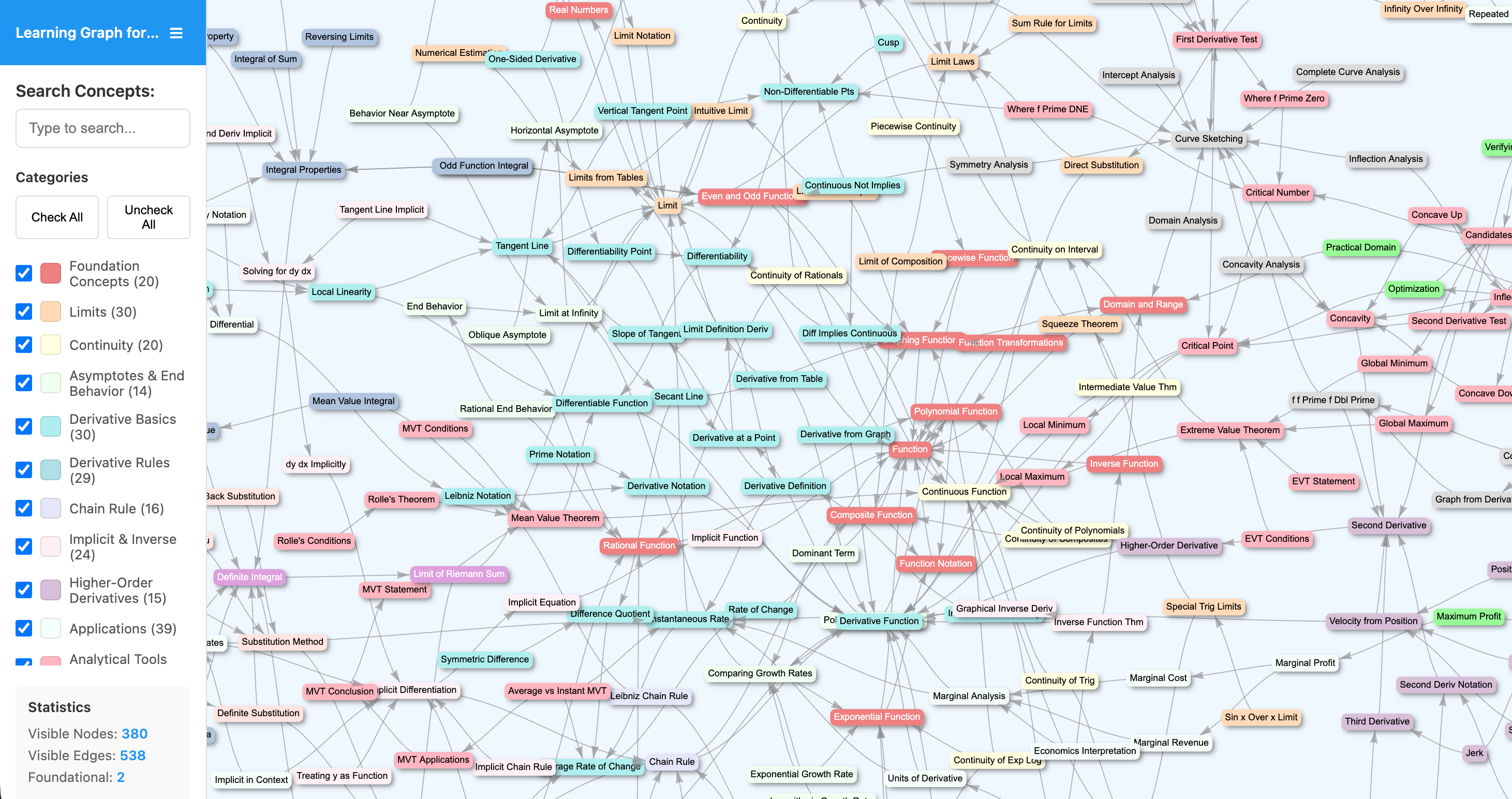
Figure 2: Interactive learning graph viewer for the calculus domain (380 concepts, 539 edges). Each node is a concept, color-coded by taxonomy category. Directed edges represent prerequisite dependencies. The left panel shows category filters and corpus statistics. All 46 domains use this same DAG structure.
Corpus Schema
All 46 domains share an identical CSV schema:
1 2 3 4 5 | |
- Dependencies are pipe-delimited integer references to prerequisite ConceptID values
- TaxonomyID assigns each concept to a domain-specific category (e.g.,
FOUNDfor foundational,COREfor core,ADVfor advanced)
Corpus Statistics
The heatmap below shows per-domain statistics across all 22 extracted domains, organized by category (STEM, Professional, Foundational). Total: 6,206 concepts and 10,342 dependency edges.
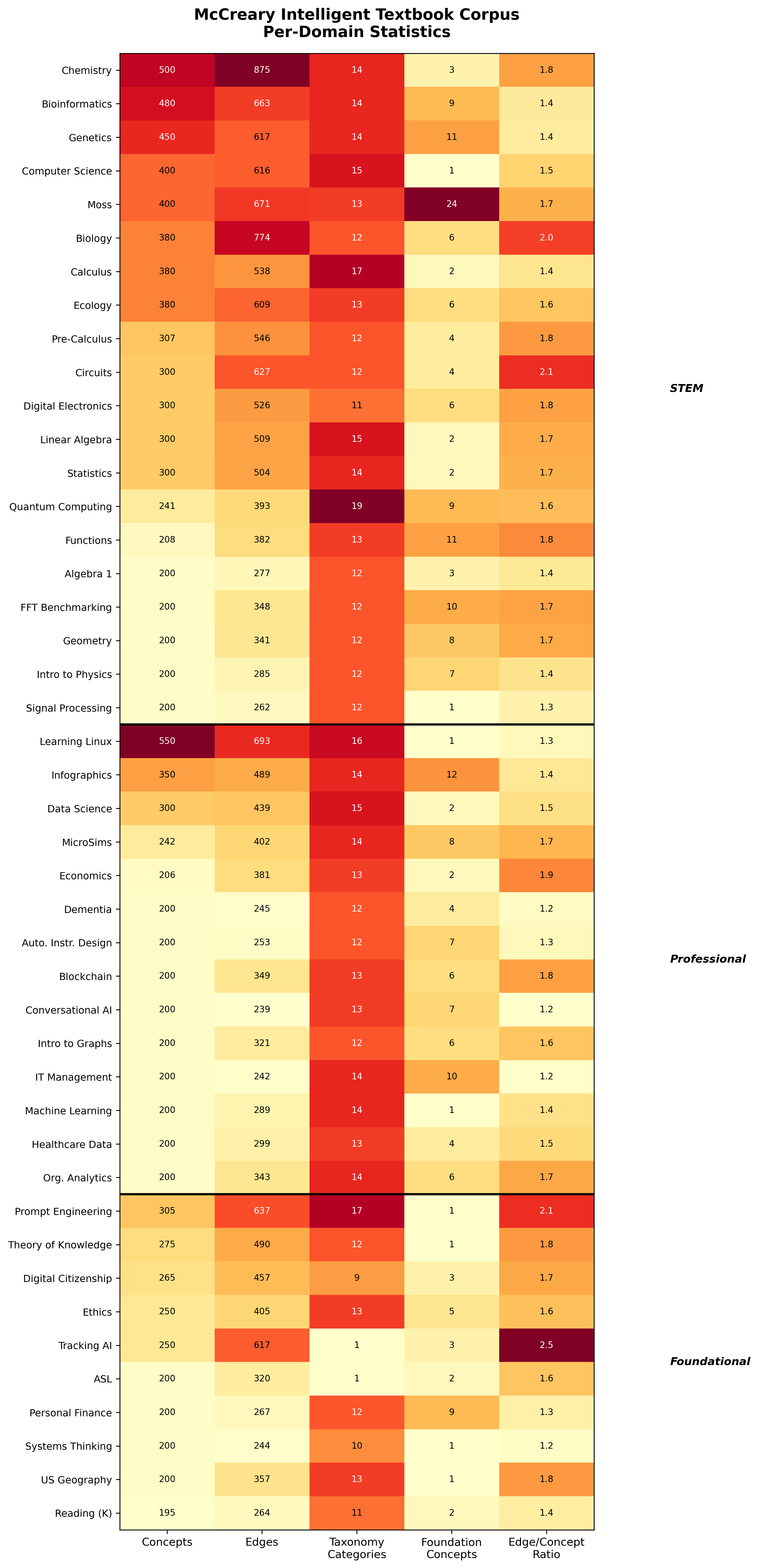
Figure 5: Per-domain statistics. Color intensity reflects relative magnitude within each column. Domains are sorted by concept count within each category.
Quality Properties
All 25 DAGs are validated for:
- Single connected component (no isolated subgraphs)
- No self-references (no concept lists itself as a dependency)
- Foundational concepts (zero prerequisites) \(\geq\) 2 per domain
- Maximum dependency chain length reported per domain